
Amid intensive efforts to reinforce its commitment to environmental sustainability, APRIL, a major player in Indonesia’s pulp and paper industry, faces significant challenges in its quest to regain certification from the Forest Stewardship Council (FSC) after it was revoked ten years ago.
In 2014, APRIL lost its FSC certification due to unsustainable logging practices and deforestation activities. This decision marked a crucial turning point for the company to deeply introspect on its environmental impact and formulate concrete steps for improvement.
Hartono Prabowo, FSC Indonesia Manager, stated that APRIL has implemented the initial stages of the framework remedy—an initiative aimed at repairing environmental damage caused by past land conversion practices. This effort was underscored by the signing of a Memorandum of Understanding (MoU) with FSC at the end of last year.
“The framework remedy is a work plan undertaken by APRIL to address various environmental damages resulting from their past land conversion activities,” explained Hartono to Tangkasi.id in Jakarta on Tuesday (16/7/2024). This process, however, is time-consuming and involves several phases that must be completed before APRIL can regain FSC certification.
Regarding the certification process, Hartono emphasized that the time required depends on various factors, including APRIL’s internal readiness and their interactions with various stakeholders involving in implementing the framework remedy.
However, APRIL’s journey to regain FSC certification has not been smooth. A month ago, reports from several non-governmental organizations, including Jikalahari-ICEL, highlighted alleged deforestation activities by APRIL and its subsidiaries. These reports have been received and are currently under evaluation by FSC International.
“Not only reports from Jikalahari-ICEL, but several alliances of NGOs at both national and international levels have sent letters to FSC International regarding potential deforestation,” revealed Hartono. “We are conducting a thorough investigation to verify the accuracy of these reports before making any further decisions regarding APRIL’s certification.”
In response to the substance of the NGO reports, Hartono stressed that FSC cannot simply accept claims without comprehensive verification. “The essence of these reports is that there are indications that APRIL group is still involved in deforestation activities,” he said.
On the Timeframe for On-Site Inspections Related to Deforestation Reports, Hartono Admits There’s No Set Target Time. Hartono explained that field conditions must be confirmed first by sending a team for direct inspection. The schedule details for these inspections still need to be determined by the FSC, as all processes related to this assessment are handled internationally, not by FSC Indonesia.
Hartono emphasized that the ongoing evaluation process has the potential to disrupt APRIL’s efforts to regain FSC certification. “The final decision will depend on the findings from detailed field inspections and APRIL’s adherence to the sustainability standards set by FSC,” he said.
Additionally, the FSC also reaffirmed its commitment to ensuring that certified companies, including APRIL, comply with established sustainable forest management standards. This process is conducted through stringent annual audits to ensure adherence to FSC principles. In each audit, FSC engages stakeholders and independent auditors to evaluate whether the company has committed any violations.
If violations are found, Hartono added, corrective actions will be applied according to the severity of the violations. This approach is considered effective in ensuring that responsible forest management practices and the cessation of deforestation are consistently implemented on the ground.
Recent Deforestation
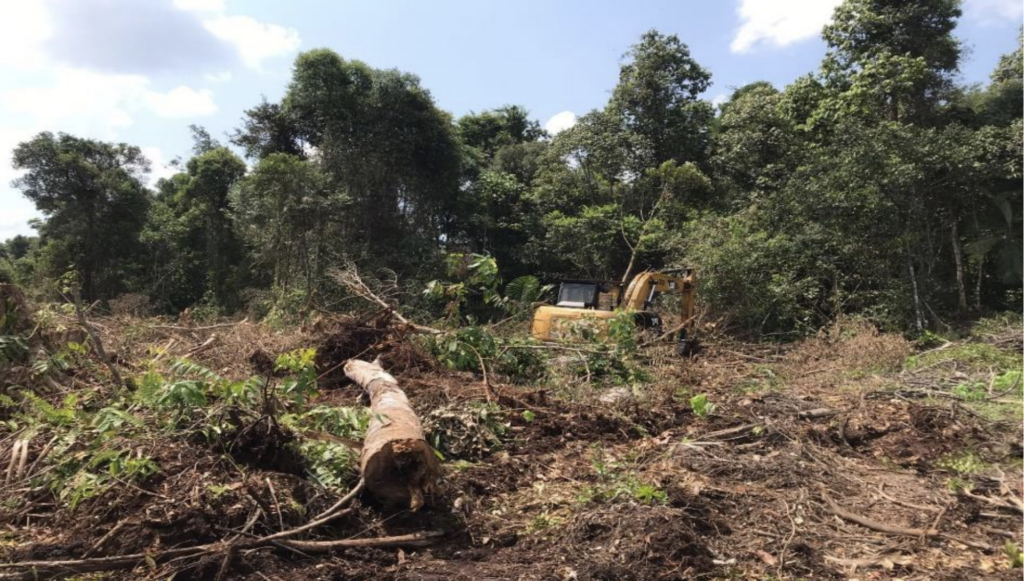
APRIL group is deemed to have violated the sustainable forest management policy commitments they had announced in 2014 and revised in 2015. These violations were revealed by Jikalahari and ICEL as APRIL was in the process of regaining FSC certification. The reports disclosed new deforestation activities in two of APRIL’s subsidiaries, PT Nusa Prima Manunggal (NPM) and PT Selaras Abadi Utama, both located in Riau.
GIS analysis and field findings by Jikalahari revealed deforestation within a landscape area of 60 hectares in the concession of PT RAPP estate Sungai Mandau or PT NPM. Clearing also occurred in APL and outside the concession of PT RAPP covering 83.32 hectares, as well as in the APL area within the PT RAPP concession covering 9.20 hectares. The clearing of natural forest borders directly on PT RAPP concession, which had just conducted harvesting and new acacia planting. The forest clearing started at the beginning of 2024.
Jikalahari stated that workers who cut down natural forests in the cleared area claimed to work for PT RAPP. Additionally, new canals were found in the natural forest clearing area, with widths of 4 meters and depths of 2 meters, and widths of 3 meters and depths of 1.5 meters. These new canals were not only found in areas already planted with acacia but also in natural forests outside the planted area, leading into the natural forest. Jikalahari referred to this as evidence of ongoing and potentially continuing land clearing.
“From satellite images, the extent of forest clearing, and new land clearing can be seen to increase every month. The clearing of natural forests in both locations was carried out simultaneously using the same excavators and labour,” said Ali in an official statement quoted by Tangkasi.id on Thursday (4/7/2024).
As previously reported, Disra Alldrick, Deputy Head of Corporate Communications for PT RAPP, denied Jikalahari’s allegations regarding forest logging. He stated that PT RAPP, part of the APRIL Group, along with its supplier partners PT Nusa Prima Manunggal (NPM) and PT Selaras Abadi Utama (SAU), claimed that the clearing of the operational areas of PT RAPP and PT NPM identified by Jikalahari occurred outside the company’s concession boundaries.
This was confirmed using the latest satellite mapping with correct concession boundary overlays and field verification. He revealed that from their review, it was found that the land clearing occurred on land managed by a local community cooperative.
Furthermore, as part of their routine monthly land cover change analysis, they identified a small area, less than 10 hectares, taken over by a local cooperative within the concession area. They have mapped and reported this area and are making efforts to rehabilitate the land.
“The local community cooperative managing the land is not a supplier partner of PT RAPP. We ensure that the cooperative does not have any agreements or contracts with PT RAPP as a supplier or for any other operational activities,” he said. (*)