
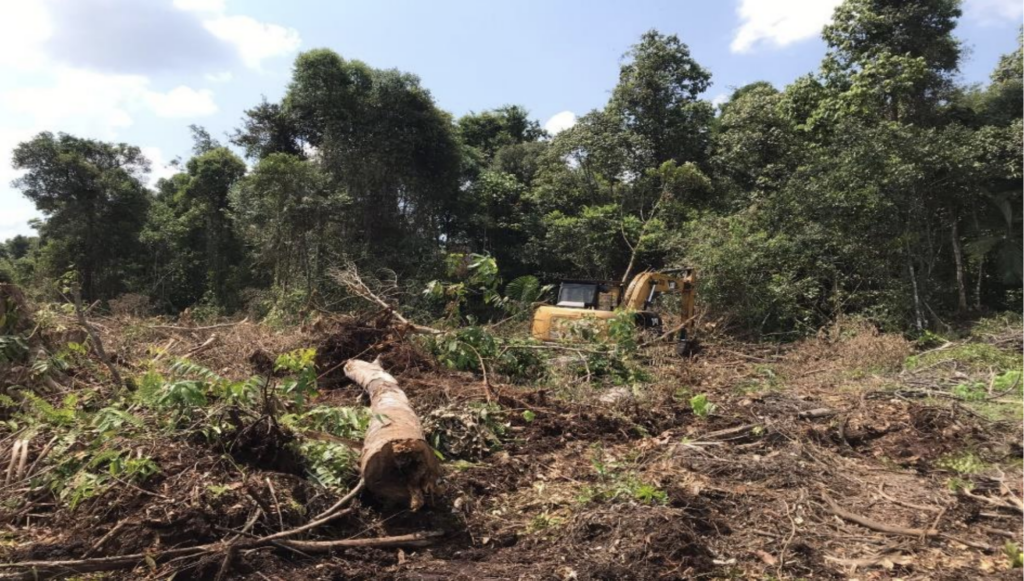
Indonesia’s major paper and pulp company APRIL Group is suspected of violating the Sustainable Forest Management Policy commitments they announced in 2014 and revised in 2015. This violation was disclosed by the Riau Forest Rescue Network (Jikalahari) and the Indonesian Centre for Environmental Law (ICEL) at a time when APRIL is in the process of re-obtaining Forest Stewardship Council (FSC) certification, which was revoked in August 2013. These NGOs are urging the Ministry of Environment and Forestry (Kementerian LHK) to impose legal sanctions, but APRIL claimed that the deforestation occurred outside of their concessions.
The report published on June 25, 2024, identified new deforestation in two APRIL subsidiaries: PT Nusa Prima Manunggal (NPM) in Siak Regency and PT Selaras Abadi Utama (SAU) in Pelalawan Regency.
GIS analysis and field findings by Jikalahari have uncovered deforestation across an expanse of approximately 60 hectares within PT RAPP estate Sungai Mandau or PT Nusa Prima Manunggal concession. Clearing has also occurred in the Other Land Use Area (APL) and outside PT RAPP’s concession, totalling 83.32 hectares, with an additional 9.20 hectares within the APL area inside PT RAPP’s concession. The clearing of natural forest borders PT RAPP’s concession, where recent harvesting and new acacia planting have taken place. Forest clearing began early in 2024.
Jikalahari reported that workers involved in clearing the natural forest in these areas claimed to be employed by PT RAPP. Additionally, new canals were observed in the cleared natural forest area: one canal measuring 4 meters wide and 2 meters deep, and another canal measuring 3 meters wide and 1.5 meters deep. These new canals are located in areas already planted with acacia, and there are also new canals within the forest outside the acacia-planted areas that lead into the natural forest. Jikalahari described this as evidence of ongoing land clearing that is not yet complete and is likely to continue.
“From satellite imagery, the extent of forest clearing and the opening of new land areas continues to increase every month. Forest clearing in both locations was conducted simultaneously using excavators and the same workforce,” said Made Ali, Coordinator of Jikalahari, in an official statement quoted by Tangkasi.id on Thursday (4/7/2024).
Satellite observations show that PT RAPP remains actively involved in forest clearing activities until April 2024. Within these areas, remnants of natural timber with diameters of 30-40 cm were found along with markers indicating PT RAPP’s presence. Outside the concession area where clearing occurred, newly planted acacia trees were observed. Worker statements, as documented in this report, indicate that these acacias were planted by PT RAPP.
In November 2023, PT NPM entered into a partnership with the government of Kampung Olak. The collaboration aimed at utilizing land for acacia plantations over two planting cycles (10 years), covering an area of 285 hectares. However, this partnership was protested by residents of Kampung Olak. This conflict was previously reported to the Siak government. In a meeting mediated by the Siak government on Wednesday (03/04/2024), as quoted from local news outlet Cakaplah dot com, the district administration requested PT NPM to halt land development activities. The meeting was attended by representatives from Siak district government, local communities, the National Land Agency, Forest Management Units, and PT NPM’s Director.
In PT SAU’s concession, Jikalahari discovered a natural forest clearing covering 50 hectares in 2023. The cleared area still contained standing natural timber with diameters ranging from 20 to 40 cm. The cleared forest area was only bordered by a canal approximately 3 meters wide and directly adjacent to the natural forest. The clearing area is located 10 km from the SP 2 Teluk Makmur community settlement in Pelalawan Subdistrict. In this RAPP supplier concession, a new canal with depths ranging from 2 to 4 meters was also found. Newly planted acacias, aged 3 months, were observed in the cleared natural forest area.
“Amid the Forest Stewardship Council (FSC) certification process, Jikalahari continues to find PT SAU and PT RAPP Estate Sungai Mandau engaged in natural forest logging, opening new canals, damaging peatland ecosystems with protective functions, and planting acacias outside their concessions without valid permits,” said Made Ali.
In November 2023, a decade after FSC revoked APRIL’s certification, these entities signed a framework agreement for improvement, marking the beginning of APRIL’s improvement process implementation. As a result, APRIL complied with all the requirements of the FSC improvement framework before being eligible for certification from the FSC. The revocation of the FSC certificate in May 2013 followed reports of APRIL’s involvement in large-scale deforestation by Greenpeace, WWF Indonesia, and the Rainforest Action Network.
FSC certification is an assessment for companies deemed to have fulfilled 10 principles in the production chain from raw material sourcing to the factory. Among these principles are legal compliance, community relations, and environmental impact values.
Threatened with Criminal Sanctions
Difa Shafira, Head of the Forestry and Land Division at the Indonesian Center for Environmental Law (ICEL), assesses that subsidiaries of the APRIL Group planting acacias outside their concessions and outside designated forest areas (APL) should have utilized the community forest (HR) scheme. Without this, Difa adds, companies should face criminal sanctions under forestry sector regulations.
Referring to Ministry of Environment and Forestry Regulation No. 9 of 2021 concerning Social Forestry, Article 1 number 10 defines Community Forest as forest land subject to property rights. This means Community Forest is located outside forest areas or other designated land uses. Community Forest must possess a permit issued by the ATR/BPN in the form of a SHM (Land Certificate). PT RAPP’s action of planting acacias outside its concession without comprehensive cooperation with local communities constitutes an illegal act.
PT RAPP also violates government legislation, specifically Government Regulation No. 57 of 2016 amending Government Regulation No. 71 of 2014 concerning the Protection and Management of Peat Ecosystems, as well as APRIL’s sustainability policy commitments.
“Alleged violations such as canal construction in protected peat ecosystem functions should be subject to governmental enforcement measures that could escalate to permit revocation based on the Peat Ecosystem Protection and Management Regulation,” said Difa.
APRIL Denies Allegations
Disra Alldrick, Deputy Head of Corporate Communications at APRIL, refutes Jikalahari’s accusations regarding forest clearing. He states that PT RAPP, a part of the APRIL Group, along with its supplier partners PT Nusa Prima Manunggal (NPM) and PT Selaras Abadi Utama (SAU), claim that the identified deforestations areas highlighted by Jikalahari occurred outside the company’s concession boundaries.
This has been confirmed using the latest satellite mapping overlaid with accurate concession boundaries and field verification. According to the company’s review, land clearing occurred in cooperative areas managed by local communities.
Additionally, as part of routine monthly land cover change analysis, they identified a small area, less than 10 hectares, under the control of a local cooperative within the concession area. They have mapped and reported this area, and are currently engaged in land rehabilitation efforts.
“The local community cooperative managing this land is not a supplier partner of PT RAPP. We ensure that the cooperative does not have any agreement or contractual relationship with PT RAPP as a supplier or in any other operational capacity,” Disra told TangkasiID on Tuesday, July 2, 2024.
Disra asserts that APRIL does not use or allow natural timber into the company’s supply chain. Raw materials are sourced from industrial plantation forests in line with APRIL Group’s sustainability policy. Compliance with this policy, he continues, is routinely audited, including by third parties.
“Regarding claims of land clearing in PT SAU’s concession area, an open market supplier to PT RAPP, the area mentioned in this report had undergone land cover changes in 2013 as confirmed by the best available satellite imagery,” he said.
He emphasized that these conditions align with APRIL’s land development deadlines set in 2015, according to the Sustainable Forest Management Policy (SFMP) 2.0. He reaffirmed APRIL’s strong commitment to avoid involvement in deforestation within our operations and supply chain, including all supplier partners adhering to the company’s SFMP 2.0 policy.
“We are also committed to sourcing raw materials responsibly in terms of environmental and social aspects, and to avoiding risks associated with unsustainable and/or illegal practices in our fiber procurement policy,” he concluded.
However, APRIL did not provide a response regarding specific findings from Jikalahari and ICEL reports concerning changes in peatlands due to canal construction connected to its concession, as well as conflicts among residents in Kampung Olak, Siak resulting from PT NPM’s contentious cooperation with the community.(*)